Sunday, July 31, 2011

Milk

At orientation, we were told not to drink the milk here or we would die. I don't really know how true that is, but they had stories about people being medically evacuated out, so we took it to heart. So for over a year we drank shelf milk or powdered milk. Then some of our colleagues started pasteurizing their own milk, so we did too.

On Saturday mornings, the milk man shows up on his bicycle. Our duplex-mates, another family, and the three of us all get milk...6 liters each. We take our pitchers and bowls outside and the milk man pours our allotted milk into our containers. Then we bring them inside. We filter them through a strainer first to get out any dirt or cow hair that might have floated in. Then we put the milk into a double broiler and heat it to about 170 degrees and hold it there for 15 seconds. Then we put the milk into fridge-friendly containers (usually old mayonnaise jars) and cool the milk down as fast as possible in ice water in the sink. Then it all goes into the fridge and we wait until it's cold enough to drink. I didn't even know how much I missed the real thing until I had it again!

When we first get out one of the jars, we have to scrape the cream off the top. The first time is the easiest because it's really thick and clings to the spatula. It's still hard to get it all off though. Sometimes there's not much cream at the top and it looks pretty harmless, so I'll just shake it up because I know it'll be difficult and time-consuming to get it all off. This can be regretful because later on, the milk will be lumpier faster and not all that appetizing.

Well last week our team had the opportunity to get away for a few days. One morning, we split up and spent about 3 hours with the Lord. One of the things that I pray constantly is that I will decrease and that God will increase. I started to think about how even though I pray that, I still find myself trying to increase. My attitude still says that I am so selfish. The way that I let things bother me says that I still think that this is somehow about me. No matter how much I pray for God to increase in my life, my attitude, my ministry, Michelle keeps rising to the surface. And when it's really obvious and huge and easier to get rid of, I allow God to scrape it off. But when it's more subtle--hideable--I tend to just shake it back down. But it's still there...which means it will resurface, it's inevitable. And it's not harmless. It turns into an attitude that permeates everything, every relationship, every word, every action...making it lumpy and un-appetizing.

God reminded me that part of the growing process is pruning. If there's something in my life that needs to go, I can't just let it sit there. And I may think it's doing nothing...just sitting there because I know it'll hurt to cut it away. But really it's keeping everything else from growing. I'm so thankful that God is willing to teach us these things! And I'm so thankful for cold, fresh milk.

Nuts & Bolts

Usually in my email updates and blogs, I mention bits and pieces of my actual job and the storying process, but a few people have showed an interest in knowing how exactly it all goes down. So I've decided to write a blog explaining the nuts and bolts of the storying process, starting at the beginning of my term. Read if you're interested...if not, no hard feelings.

First Six Months

When I first arrived in Mali last April, I was told that my full-time job was to learn the Sunny language and culture. We lived in the village (Yosemite) 5 days a week and came into a small town (G-Vegas) 2 days a week to rest up, run errands, etc. Every day in the village, I would go meet with a language helper (Jenny) to get new vocabulary and the rest of the day I'd go visit people and practice talking. To learn the culture, we did and still do two simple things: observe & mimic. Our primary goal was to become Sunny women (right down to our new Sunny names), but we were careful to only do this with cultural aspects of life...not religious. It's one of the best compliments ever when somebody looks at you or hears you or watches the way you do something or asks your name and says, "You are a Sunny woman!"

The Why

Well...because the Bible is not available in the Sunny people's heart language yet. And even if it was, none of them could/would read it. They are an oral people group. For centuries, they have passed down information orally. All of their history and traditions are taught to the generations through story-telling. This is how they teach and how they learn and they are awesome at it. So, when we know that we have the most important message they will ever hear, why wouldn't we present it the way they will receive it? Someday, the Bible will be available to them in their heart language, and someday they will want to read it, but for now this is the best way for them to have the opportunity to hear the gospel.

Pre-Story Set

After spending time with our people, we began thinking on a redemptive theme for our Story Set and which Stories would best support and illuminate that theme. The reason we go about it this way is because every people group is different and we want them to hear the full gospel in a way that will most resonate with them. Now, the gospel doesn't change and it's the Holy Spirit that reveals it to people, but we want to make sure that we're doing our part for the truth to sink in as quickly as possible. And if that is more likely to happen, for example, by emphasizing the sacrificial aspect of salvation, then Stories that show God's purposes of sacrifice are likely to be included.

We spent several months praying for direction and wisdom, observing our people, speaking with colleagues, and talking to each other to decide on a redemptive theme that would most speak to the Sunny people. We settled on "Jesus is the Only Way." Our people are very (VERY) conservatively M. Every single day, we watch them get up from what they are doing, go wash themselves, retrieve their prayer beads, lay out their prayer mats, turn East, and go through the recited prayers. They make the atoning sacrifices. They make the prescribed statements about Allah and His prophet. They attend Qu-ran:c school. They loyally walk the M Road daily. It breaks our hearts to see them walk a road that we know will not take them where they want to go. So we knew that pointing them onto the Jesus Road...the Only Way to God...would speak to them. Even their terminology speaks to this...the phrase "Jesus Road" and "M Road" comes from them, not us.

We purposely chose Old Testament stories that would point to Jesus as the Only Way to redemption...the way that God Himself provided. And we chose New Testament stories that verify that Jesus is exactly who God says He is...the Son of God, the Promised Savior. The actual Story Set list took several days to compose and is still in the works, but right now there's a list of about 30-33 Stories that will most likely be included in the final Story Set that will be recorded onto cassette tapes for distribution to our people.

The People

NICK: This is our story crafter. He speaks Sunny and English (and about 12 other languages). He is a believer, but is not very open about it yet. He wants very much to become open about his faith, but is praying for wisdom on how to do that because his ultimate goal is to be a catalyst for the Sunny people as a whole coming to faith in Jesus. He knows a lot about Sunny culture and has traveled quite a bit around the country, so we included him quite a bit while we were choosing Stories to include in our set.

BRIAN: This is our back-translator. He is not a believer, but is actively seeking. He speaks English and hears Sunny, but does not speak it all that well. He also speaks Bambara and French. I'll explain the back-translating process more below.

TESTING GROUP/TESTERS: This is how we describe a group of women on whom we test our story once it has been recorded and back-translated. They can be found at a few different houses that we have spent the last several months building relationship with.

ABBY/SOKONA: This is one of my teammates. Her term technically started 3 months ahead of mine, but she plans to extend 3 months so that our terms will both end in January. She has the mind of a steel-trap and can remember vocabulary that I don't even remember learning! She's from Georgia.

SARAH/MAGOU: This is my other teammate. She and Abby were college roommates and they started their terms at the same time. She can hear the Sunny language like crazy. These women will get to talking insanely fast, but Mags will still know what they're talking about! She's from South Carolina.

JUDY/NAFI: This is our supervisor. She is passionate about making the Word of God available to oral people groups and has supervised several teams like mine who were creating oral Story Sets in various languages. She's from Kentucky.

The Process

1. Abby will gather several resources...different versions of the Bible, our storying training book, a translator's program on the computer, etc...and craft the Story (in English). She will include any questions we need to address with Nick, any Key Terms, as well as reasons she chose to word something a certain way, or include/exclude a certain part of the story. This goes into a Word document.

2. Sarah and I will gather all of the resources Abby used and revise the story. We write down any concerns, add our own questions for Nick and/or Abby, and do any editing that needs to occur.

3. Abby schedules a Crafting Session with Nick and gets everything ready for it.

4. Abby and I meet with Nick to craft the Story. We tell it to him orally (in English) and then he verbalizes any immediate concerns or suggestions he has. We ask him all of our questions and tell him the non-negotiables of the story...meaning...if he wants to change something for the sake of contextualization, we have certain things that cannot be changed in order to maintain the integrity of the Word of God based on research with Bible translation. Then he reads the story for himself a few times to familiarize himself with it even though he already knows it. We make any changes that need to be made, then we record him telling the story (in Sunny) on one of our voice recorders.

5. Then I get the story ready for the Back-Translation session. I type up a new Word document that has any questions that we have for Brian. I list out all of the Key Terms so that we can make sure we have the right Sunny words for them. (Example of a Key Term: Adam) Then I call Brian and set up a time to meet for the session.

6. Abby and Sarah go meet with Brian. They take the voice recorder and some speakers and play the Story all the way through for him. Then they will play it again one line at a time. As he translates the line from Sunny back into English (hence the term back-translation), Abby will type the English version into another Word document. They will make sure that all the questions are answered and that all of the Key Terms are understood and translated. We do this step because even though the Story was crafted in English, once it changes into Sunny it's worded differently. And even though we speak some Sunny, we still need a Sunny person to tell us exactly what it says word-for-word. The reason this has to be a different person than the crafter is because the crafter knows what he's trying to say and would tend to just translate it back the way he wants it to sound. Here's an example from our Story of Abraham sacrificing Isaac: The line, "When they were near to the place of sacrifice Isaac asked his father, 'I know that we have the fire and the wood, but where is the lamb?'" becomes this in Sunny, "While they were getting closer to the place, Isaac said, 'Now I am seeing fire and I’m seeing firewood, but the sheep we are going to kill…I’m not seeing that.'" This step just ensures that even though the wording may change because of the way Sunny people speak, the meaning of the text is still communicated and understood.

7. Then Abby will create an Excel document. Each line of the story will be inserted into a row in its English form. Under each line there is a place to list the Anchor (scripture reference...every line MUST have an Anchor), any Key Terms found in that line, a place to include any notes to explain how and why that line is crafted the way it is, a place to list Testing Questions and Answers, and a place for Nafi to add any notes/suggestions.

8. Sarah and I will go through the Excel document and come up with as many Testing Questions as we can to make sure that the Story is being understood by Sunny people in the way it should be according to the original intent of the Bible. We also put any information that has already been obtained into a Key Terms tab and a Cultural Notes tab of the Excel document. We list all questions onto a piece of paper for the Testing Session and schedule a time to go meet with a Testing Group.

9. Abby and Sarah will go to one the houses that we have built relationships with to test the Story. They will play it through a full time and ask if they understood the language in the Story. Then they will lay it through line by line and ask the questions corresponding to that line. They'll also make sure that the Key Terms are correct and understood. Most of the time, the testers will offer more information on the Key Terms according to their own culture because most of the Old Testament stories are already known by our people. At the end of the session, the girls will ask somebody from the testing group to retell the story. This shows us if the story is memorable and easy to understand. If an important part of the story is left out in the re-telling, we know that we might need to emphasize it differently or that maybe it wasn't understood very well or that maybe the story is too long. The entire session is recorded in Sunny and English.

10. I will listen to the recording and enter the Testing Answers into the Excel document. I will also add all Crafting Notes, Key Term Notes, and Cultural Notes into the appropriate places. I'll go through all of the tabs and do any editing that needs to be done in order for the document to be ready for submission to Nafi.

11. Abby will email the document to Nafi and wait for her to email back with any changes that need to be made or more Testing Questions that need to be asked.

12. All necessary changes are made and the document is ready to be re-submitted to Nafi. Then...hopefully...we have an approved Story! Just FYI, we currently have 16 of the Stories somewhere in the process. We split up the tasks so that we could be more efficient in our work and we also believe the work is of higher quality because of this. God really put the 3 of us together in a way that we each enjoy and thrive in doing different parts of the process. It's been amazing to watch Him work in our team. We switch off sometimes as needed, but the way I've listed it is true most of the time for now.

13. Eventually we will begin the process of making the final recordings that will be put onto cassettes for distribution, but I don't know what that looks like yet.

Whoa. If you've made it this far, thanks for reading!


Friday, June 3, 2011

All Downhill

Rain is one of the things I miss the most about America. And heat has been one of the hardest things to get used to in Mali. Which means that I pretty much adore rainy season out here. It's short and sweet...and still hot...and a lot more humid...but it RAINS...and for a few glorious hours afterwards it feels fantastic outside.

Rainy season also means that your electricity goes out a lot more. And the other day, the 3 of us were sitting at our kitchen table working on some stuff and the electricity kept going out. We were getting a little agitated because we needed the internet...and most importantly, a fan. But then it would come back on and we'd celebrate briefly. Then it went off for a longer while...but THIS time we noticed that it was all dreary-looking outside...and the wind was kind of picking up. We ran outside and sat on our porch and waited...while everyone else on our street packed up everything to run inside. I know...crazy white girls. It got crazy windy and then slowly...one by one...giant cold raindrops started falling. Then the wind picked up and the rain came faster. The kind that makes you suck all your air in real fast when it hits you because you were just sitting in a 100 degree living room and now you're being pelted by cold rain. We stayed until we were soaked through and couldn't stand the cold any longer. I bet it got down to 80 degrees out there! Rainy days are ALWAYS good days...even if you do get the truck stuck in the mud :)


Wednesday, May 18, 2011

A Different Easter

Ever since I was little, I have LOVED Easter. I admit...it mostly had to do with gift-giving bunnies, dyed eggs, plastic-grass-filled baskets, and purple Easter dresses. I loved that one Saturday afternoon when my mom would spread a newspaper out over the kitchen table and put out coffee mugs filled with vinegar, one for each colored tablet that came in the egg-dyeing kit. Did anyone else always want to eat those tablets? They looked like my Flintstone vitamins, which I loved. One by one I'd drop the tablets into the mugs and watch the beautiful colors appear. And then I'd get that little wire egg-lowering-and-raising device and start coloring the carton full of eggs.

As I got older, I began to more deeply understand the significance of Easter. It's about our risen Savior. I would attentively listen to my Sunday School teachers deliver the story I knew well. I would read the passages of Scripture which tell the story I knew well and I would celebrate with the other people at church over God's perfect redemption plan and His power over death. But...Easter Sunday still had a lot to do with getting to wear a new dress.

Then as I began serving on staff at a church, Easter took on some different meanings and I didn't even realize it. It became about making sure I had Sunday's lesson planned perfectly for all the kids that would be visiting for the first time. It became about planning parties and egg hunts and making sure there were enough snacks. It became about having a back-up plan if we ran out of chairs. Now...all of these things are perfectly fine...it's just that sometimes I allowed these things to become more important to me than our risen Savior. I let the stress of busy-ness steal my joy...and that is not perfectly fine.

This year was different. My teammates were on vacation, my supervisor was out of town, and we had a company Easter celebration on the Saturday before. I decided to go spend Easter with some friends in a town about 3 hours from here, called K-Town. Our Jman friend, Scott, and 5 guy volunteers are serving out there. They spend weekends in K-Town, but spend most of their time in various villages outside of K-Town. The main one is called the Dunes.

Here's the story...to the best of my knowledge...of the Dunes. Several years ago there were 2 Jgirls doing the same thing that my teammates and I are doing. They crafted a chronological Bible story set into the language of the Dunes. They recorded the Stories and distributed the tapes. They never got to see any of these people choose the Jesus Road. BUT after they left, the power of God's Word reached a handful of these people and resonated within their hearts as the truth that it is. So Scott encourages and equips this handful of believers in the village. He has modeled and taught Christian living and leadership and is essentially training one of the men to be the pastor of this village church.

Saturday night, when I arrived in the village, I got to meet everybody, got settled in, set up my tent, and took my bucket bath (I was a little out of practice, but I realized I REALLY missed being in the village). Once everybody was gathered together, Nya (the leader of the group) began to lead us in the Lord's Supper, and it was absolutely, hands-down, my favorite experience since I've been in Africa. There was no table at the front of a sanctuary holding all the platters of bread and juice. There were no deacons spanning the pews to pass out the elements. No little cups. No crackers. I wasn't sure how it would go. By the time we all congregated, it was completely dark outside. There were about a dozen of us, sitting wherever we could find a place, crowded around a flashlight in the middle of the African bush.

The guys had brought in some bread from K-Town and Nya proceeded to make the juice. We used a drink mix called Jolly Jus in cola flavor. One packet of this stuff makes 2 liters of juice...Nya used 2 packets for 1.5 liters. It was pretty stout. Then Nya read the passage of the Lord's Supper from a Bambara Bible and then spoke about it in his own language. Scott translated a little for me. I couldn't even tell you what all Nya said, but it was the most powerful Lord's Supper experience I've ever had. Maybe it was because I knew so little of what was being said. Maybe it was because there was little to look at besides a flashlight. Maybe it was because I knew that this was the first time this group of believers had ever taken part in this ordinance together. Whatever it was, I've never been so aware of what the original Lord's Supper must have been like. I've never been so aware of how important it is for us to partake in it in remembrance of our Savior. And I've never felt so connected to fellow believers...even though we don't speak the same language.

Then Nya gave each of us half a loaf of bread and a (pretty big) cup full of Jolly Jus. As he individually handed the elements to each of us, he said what they represented and why we do what we were doing. Again...pretty powerful. And then we all ate and drank. Then we sang!

The next day, I put on my best tie-dye and we all just hung out together in celebration. Scott would read Scripture passages of the weekend's events. I went with two of the guys to visit their village. Went and met some more people in the Dunes. Unbraided a little girl's hair and let some other little girls braid mine. Watched Scott kill dinner. All in all a great day. Then everybody met back up to eat together. We had chicken and pasta...one of my favorites! I shared a bowl with two of the African men (this usually would never happen, but I was a guest and it was Easter). In our bowl was the chicken's entire head, some giant organ, and a big beautiful piece of white meat. The head was closest to me, but as I was looking at it, figuring out my attack mode, one of the men flicked it toward himself, the organ toward the other guy, and the white meat at ME! Happy Easter!

Later that night, we gathered again. Nya read from the Bambara Bible and then spoke for a short time. And then we all sang again. We sang lots and lots of songs in various languages. I think some were Bambara, some were the Dunes language, and some in English. It was just a great weekend...definitely the best time I've had in Mali, and probably the best Easter ever. It was so encouraging to get what one of the guys called "a glimpse into our future." Abby, Sarah, & I are working furiously to finish a Story set in the Sunny language, but we know that we will most likely not get to see the fruit of it. Although we try to strike up spiritual conversations whenever we can, we probably won't get to lead a Sunny person to Christ, or watch a Sunny person's face as the Truth clicks. But Scott and the guys were very convinced and very encouraging that a few years down the road, a group of Sunny believers will also be having the Lord's Supper for the first time.


Sunday, April 3, 2011

Do you know "Toto?"

I've spoken of him in my email updates, but not on my blog...so let me quickly introduce you to one of our best friends, "Brian." He's also our back-translator for Stories. We call him Brian because one day we were driving around in the truck and he saw one of our cassette tapes with Brian Adams on it. And all of a sudden he breaks out with, "Look into my eyes....and you will seeee...whaat you mean toooo meeeee...." Before we knew it, we were belting out Brian Adams' chart-topping Robin Hood soundtrack hit, "Everything I Do." So that's Brian.

Brian's family has a farm on the outskirts of town, so we told him we'd like to go visit. He told us to be at his house at 8 am one Sunday morning. We arrived and he sat us down to eat breakfast while he got things ready for the day's outing. He was running around with a backpack, putting things in it. He went into a room and yelled at me, "Niame', do you all eat chocolate?!" I said that Magou and I do, but Sokona can't. He looked a little distraught and said, "Oh no, I don't have American peanut butter." Turns out he was preparing chocolate sandwiches for a snack. So we stopped by our house on the way out and picked up some American peanut butter for Sokona. And the chocolate was homemade. And delicious.

When we got to the farm, we noticed that there were some tiny little baby goats. Super tiny. The chickens were bigger than them. So we went over and picked them up and carried them around. Noticing that we were enjoying the animals, Brian says, "Do you know 'Toto?'" I say, "Like the little dog??" He says, "YES! Like the little dog. We have a lot of those. Do you want to see them?" Well of course we do, Brian. So we venture out to a little field where we see a small penned-off area. I'm expecting to see a bunch of yelpy little dogs in there, but instead we see a bunch of huge turtles. I think to myself, "Oh, looky there...they have turtles too. Well, where are all the dogs?" It took me a few minutes to realize that "toto" is Malian English for "turtle." The turtles were great fun, though. One was so big that even with Brian standing on it, it could still walk around!

We spent the rest of the day walking around the farm, stopping to inspect different plants and what-not. We stopped by the well to pull up water for the sheep. Brian was pretty impressed with our well skills. Every so often Brian would lead us in a song. He showed us the different types of mango trees. He had us taste different fruits that we'd never seen before...it was a great field trip. Then he took us down to a creek. We tried to catch tadpoles and minnows. He's an artist, so he got some mud from the creek and sculpted a cow out of it. Then he gave us some mud and helped us make some animals too. I made a toto.

There's another story from this day...but it's slightly inappropriate, so I'll tell you when it's not on the world wide web.

Pictures from the day:

Baby goats.

Brian on a toto.

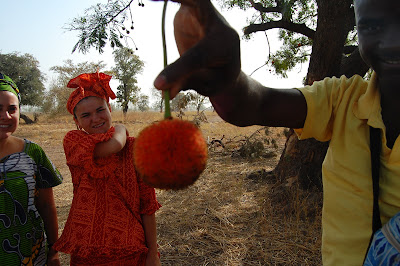
Weird orange koosh ball flowers than hung from a tree.

Catching tadpoles.


Dogon Country

One of the guys that works here with another people group had 5 more guys join him as volunteers for the semester. They call themselves Cinco de Mali...so the original guy started calling himself The Big Tamale...and we three girls are now known as The Chimichangas. It's ridiculous, I know.

So after the guys had a week of training, Nafi took us all up to Dogon Country to do things like climb mountains, scale cliffs, and look at 1000's of years old human bones in caves. It looks a lot like the Grand Canyon, but the Dogon people build their houses into the side of these cliffs. So you'd be standing down in the canyon looking up, and at first you didn't really notice it, but when you looked closely, you'd see an entire village carved into the side of a cliff. I don't care who you are, that's pretty cool. You should really Google some images. So we climbed up and down those cliffs, visiting the people and taking lots of pictures.

One of the places we stayed had a pond next to it with dozens of crocodiles. We were pretty fascinated by them. Everybody was just standing there watching them when on the other side of the pond, Sarah and some of the boys started freaking out. Apparently this baby crocodile was just floating there, minding its own business, when one of the giant ones came up behind it and chomped down. I'm not gonna lie, at first I just figured that it was the mama trying to get its baby away from all the human folk. But sure enough, about 10 minutes later, the giant crocodile emerged from the water with the baby in its mouth and just started chowing down. The translator said that it is bad news for the goats and sheep when the crocodiles resort to eating their own young.

We also hiked up a cliff to these "Telem graves." Again, you should Google it. It was one of the more tricky hiking maneuvers we had to do, but once we got up there it was worth it. There were all of these carved out areas in the cliff and then the people had built little rooms. Dead bodies would be lifted up on a pulley and left in these graves. There were human bones all over the place and our guide said they were thousands of years old. It was pretty crazy. And kind of crunchy.

Here are some pictures:


Kind of blurry, but here's a room of bones.


Cliff houses.


Crocodiles!


Nafi & the Chimichangas.

It's Always Sunny in Mali

In February we had the opportunity to travel to another area of the country for a Sunny festival. We left on Valentine's Day for an 8ish hour drive...a good part of it being on a pretty bad road. So we packed up our freshly baked heart-shaped sugar cookies and newly created all-love-song playlist and loaded up in the truck. I was getting over strep at the time, but that didn't stop us from singing so loud to our awesome playlist that we were all pretty hoarse by the time we arrived.

The first day was a parade at the soccer stadium. Seating in the shade was limited so we all split up. I sat next to this little old man. There were hunters in the para
de and every so often they would shoot off a gun for no real reason at all. Every single time I would jump halfway out of my seat and the little old man would laugh and say, "Hahaha...you're scared!!!" Every. Time. He also thought I spoke French (since I'm white) so he kept translating the Sunny speeches into French for me. I didn't correct him, I kind of liked the attention.

We got to meet a TON of Sunny people from several different countries so we learned a little bit about other dialects. It was pretty cool. We also got to meet some different people who work with other organizations. Some of them are even not from America, so we got to brush up on our British accents. Always a good time.

Here's a couple of pics from the parade: